
A full service Milwaukee jeweler specializing in custom designed jewelry and engagement rings. We hand select pieces from across the world and are proud to offer the latest trends in fine jewelry.

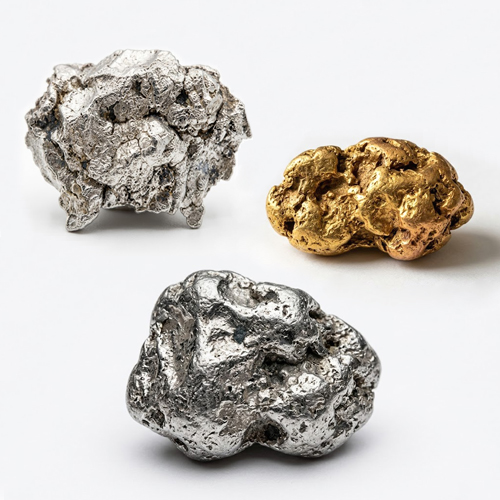
As gold and platinum prices continue to climb toward historic levels, some fine jewelry purchasers are looking for a way to maintain the prestige of a rare precious metal without the escalating price tag. Palladium has emerged as an increasingly popular alternative, offering the same high-luster, naturally white appearance of platinum but at a more accessible cost.
When it comes to choosing the ideal precious metal for a lasting piece of jewelry, the decision often comes down to gold, platinum, and palladium. These metals possess distinct physical and chemical properties that significantly impact both the design process and the long-term wear of a ring. Understanding the nuances of their weight, malleability, and how wear over time is essential for anyone looking to balance high-end luxury with everyday practicality.
Here are the main things to keep in mind when deciding between gold, platinum, and palladium.
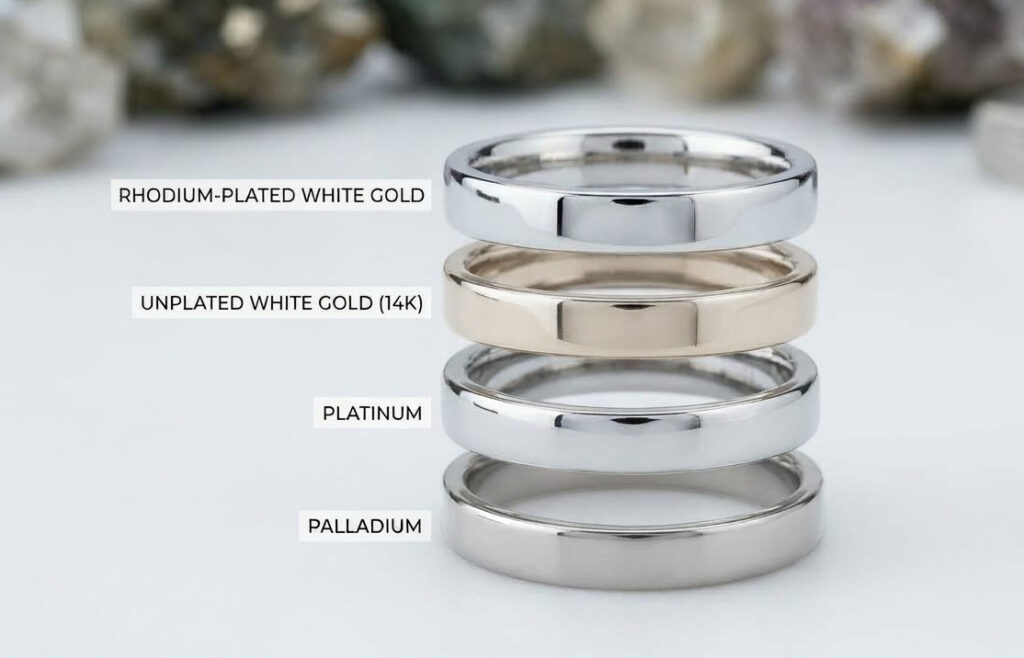
Color. Gold is mixed with other metals to create a white, yellow, or rose appearance. If you’re looking for a yellow or rose-colored metal for your jewelry, gold is definitely the option for you. If you’re looking for a silver-colored precious metal for your jewelry, you can choose between white gold, platinum, and palladium. White gold and platinum look very similar at first. However, over time, white gold jewelry can lose some of the rhodium plating that gives it that white appearance and the jewelry piece can take on a yellowish color. Platinum will always remain white. Palladium has a slightly darker color compared to platinum.
Weight. Platinum is the heavyweight of the group. It is roughly 60% denser than gold and nearly twice as heavy as palladium. Because of this high density, a platinum ring feels substantial and “expensive” on the finger, providing a reassuring weight that many find desirable for an engagement or wedding band. Gold offers a middle-ground weight that feels familiar to most jewelry wearers. Palladium, on the other hand, is the lightest of the three precious metals, making it an excellent choice for those who prefer a “barely-there” feel or for large, statement pieces that might otherwise be uncomfortably heavy in platinum.
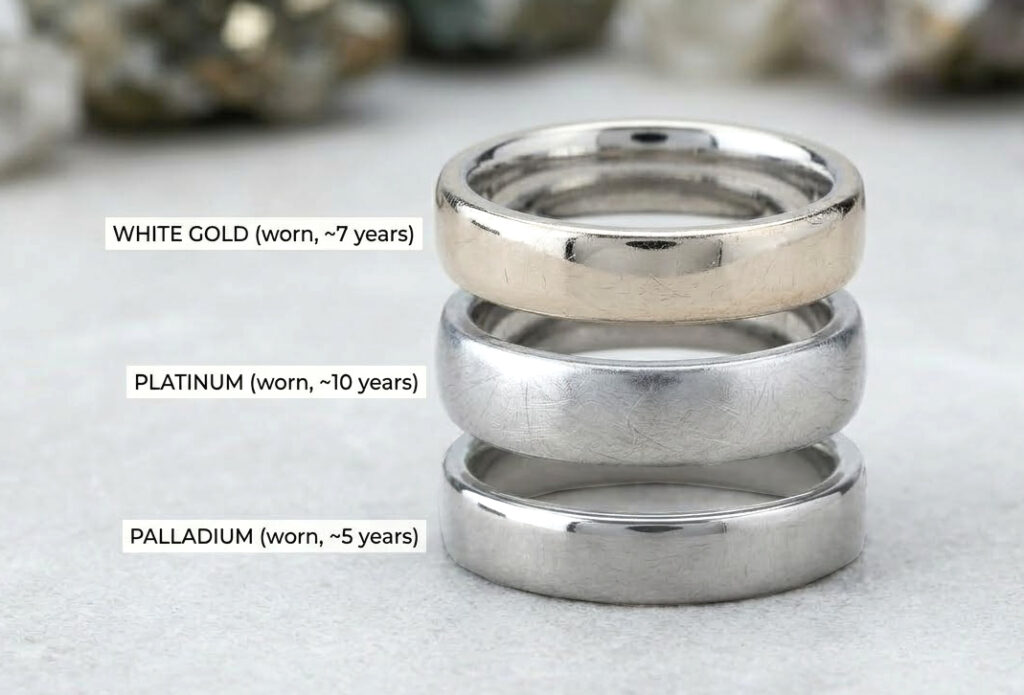
Appearance Change. Each of these metals interacts with the environment and daily wear in a unique way, resulting in a different “aged” look over the years. Because white gold is rhodium-plated, it will eventually lose its crisp white color and reveal a warmer, yellowish undertone as the plating wears thin. White gold jewelry will also show scratches over time. Platinum, conversely, is a softer metal that doesn’t actually lose volume when scratched. Instead, the metal is displaced, creating a velvety, matte finish known as a “patina.” This gives the jewelry a soft, heirloom character that many enthusiasts prefer over a high-gloss finish. Palladium behaves similarly to platinum, but because it’s a harder metal, will typically resist that matte patina for a longer period, maintaining its steely, gunmetal-grey brilliance with less noticeable surface shifting over time.
Hypoallergenic. For many jewelry wearers, one of the most important differences between precious metals is how they interact with the skin. White gold is an alloy that traditionally uses nickel as a whitening agent. Since some people have a nickel allergy, this can lead to skin irritation once the protective rhodium plating wears down. Platinum and palladium, however, are naturally hypoallergenic. Because they are typically used at 95% purity and do not react with sweat or body oils, they are the perfect metals for anyone with sensitive skin.
Workability. From a jeweler’s perspective, the difficulty of crafting a piece is largely determined by the metal’s melting point and its physical temperament under a torch. Gold is generally the most straightforward to work with. Its lower melting point and consistent alloy behavior make it easy to cast, solder, and resize using standard shop equipment. Platinum, however, is far more demanding. It requires an extremely high-heat oxygen-hydrogen torch to reach its melting point, and jewelers often have to use a dedicated set of tools just for this metal. Palladium is arguably the most temperamental of the three. While it shares some of platinum’s traits, it is notoriously “gassy”—it absorbs oxygen when heated and releases it as it cools, which can lead to pits or brittleness in the finished piece. This sensitivity to heat and its tendency to crack under stress mean that not many jewelers have the specialized induction casting equipment or laser welders required to repair or resize palladium correctly.
Cost. When budgeting for a piece of jewelry, the metal’s price per ounce is only one part of the equation. The final price tag is a combination of purity, density, and the labor required to work with the metal. Platinum is often the most expensive choice for a finished piece because it is used at high purity (typically 95%) and is significantly denser than its counterparts, meaning more metal is required to create a ring of the same size. Additionally, its high melting point and toughness require specialized tools and more time for a jeweler to polish and set. White gold is usually more accessible because it is an alloy (14k is only 58.5% gold), allowing for a lower metal cost, and it is much easier to cast and finish. Palladium currently occupies a unique position. While its market price has historically been lower than platinum’s, its extreme rarity and the difficulty of working with it, can result in labor costs that rival or exceed those of platinum. If the jewelry piece is relatively simply, a palladium jewelry piece should cost less than a platinum one.
A full service Milwaukee jeweler specializing in custom designed jewelry and engagement rings. We hand select pieces from across the world and are proud to offer the latest trends in fine jewelry.